Uzbekistan Holds Its Main Rate at 14%: What It Means for Deposits and Loans
On 16 September 2026 the board of the Central Bank left the main rate at 14% per annum — its sixth decision in a row this year. Using Central Bank data, we look at what is happening to soum deposit and loan rates, to inflation and to the soum exchange rate.
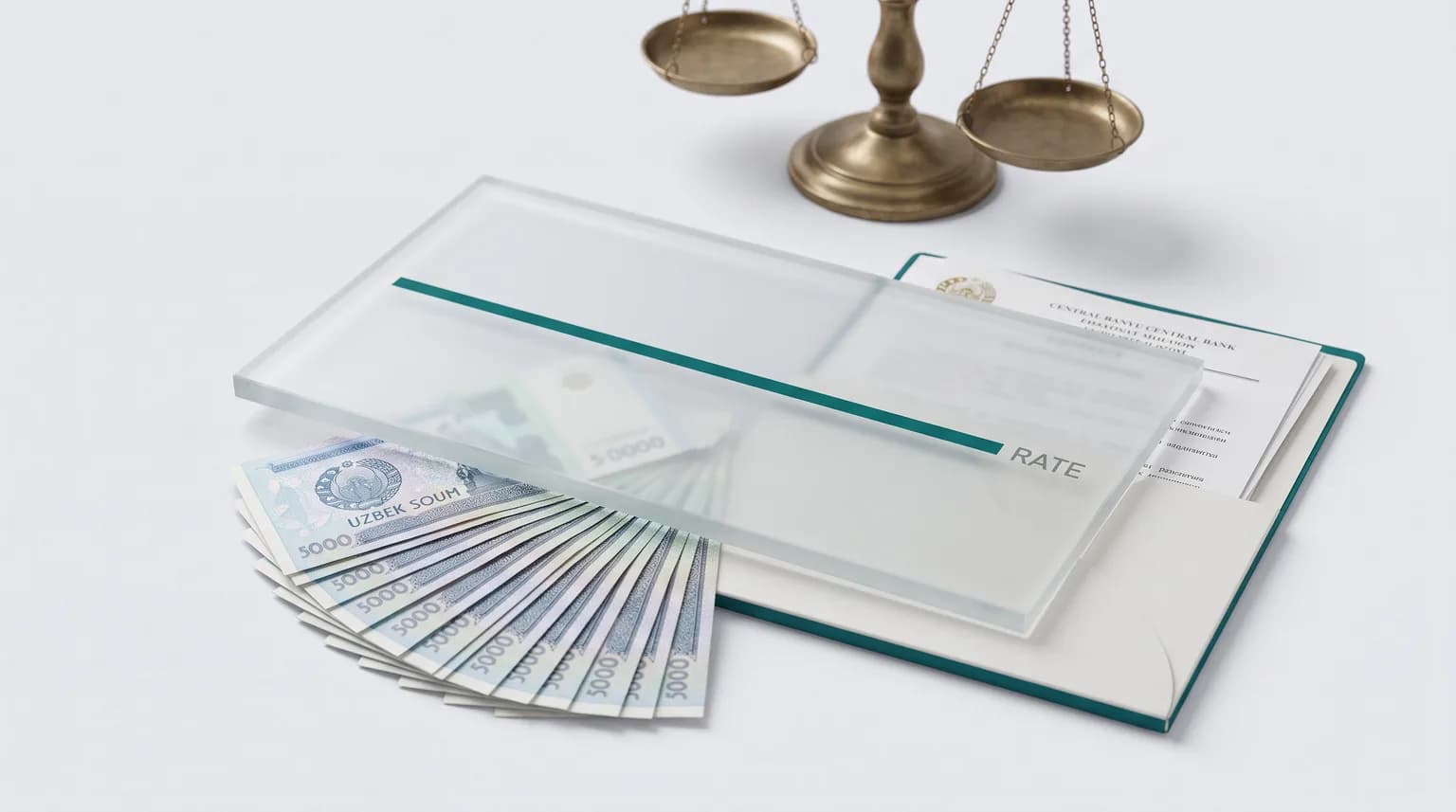
In brief: on 16 September 2026 the board of the Central Bank of Uzbekistan held its main rate at 14% per annum — the sixth decision in a row in 2026 and a year and a half without a change (the rate was raised to this level on 20 March 2025). For the reader this means expensive loans and high interest on soum deposits will persist at least until the next meeting on 28 October 2026. The weighted average rate on term deposits of individuals in soums stood at 19.2% per annum in June 2026, and lending to households at 21.4% (Central Bank data as of 7 September 2026).
What the Central Bank decided on 16 September 2026
The wording of the Central Bank press release of 16 September 2026 is direct:
"Despite the continuing decline in inflation and the emergence of individual signs of more balanced economic dynamics, the persistence of certain pro-inflationary risks requires maintaining the current tight monetary conditions." (translated from Russian)
The rest of the Central Bank's message: inflation in August was 6.2% and core inflation about 5.5%; the share of goods and services rising in price faster than 5% a year is growing; inflation expectations are falling more slowly than headline inflation, which "points to the persistence of a certain influence of inflationary inertia"; credit growth rates are "gradually normalizing," while positive real rates support the propensity to save; the target is 5% by the end of 2027.
Why the Central Bank is not cutting the rate with inflation at 6.2%
The gap between the rate and inflation is 7.8 percentage points: money stays expensive so that demand does not push prices up. And demand is buoyant: according to figures cited by Deputy Prime Minister Jamshid Kuchkarov, GDP grew 8.5% in the first half of 2026, to 1,072.7 trillion soums (as reported by InvestFuture on 25 August 2026 and Gazeta.uz on 16 September 2026). Annual inflation per Central Bank data: August 2026 — 6.2%, July and June — 6.4%, May — 5.5%, January — 7.2%; in August 2025 it was 8.8%.
On the discrepancy in the figures. According to Gazeta.uz on 16 September 2026, Deputy Prime Minister and Minister of Economy and Finance Jamshid Kuchkarov told a session of the Legislative Chamber of the Oliy Majlis on 15 September that annual inflation was 6.4% — 2.3 percentage points lower than a year earlier; on 16 September the Central Bank cites 6.2%. There is no contradiction: the deputy prime minister was reporting on the first half of the year, and in the Central Bank's series inflation held at exactly 6.4% in June and July, falling to 6.2% only in August.
The path of the main rate: a year and a half at 14%
Until 20 March 2025 the rate stood at 13.5% (in effect since 26 July 2024), after which the Central Bank raised it by 0.5 percentage points to 14%, applied from 24 March 2025 (Buxgalter.uz, 20 March 2025). In 2026 the board reviewed the rate on 28 January, 18 March, 29 April, 17 June, 29 July and 16 September — and left it at 14% every time (archive of Central Bank press releases).
What a 14% rate means for soum deposits
Banks take their cue from the main rate but pay depositors noticeably more than it. Per Central Bank statistics (the section on deposit and loan rates in the national currency, latest data for June 2026, published 7 September 2026):
| Indicator | June 2025 | June 2026 | Change |
|---|---|---|---|
| Term deposits of individuals | 21.4% | 19.2% | −2.2 pp |
| Term deposits of legal entities | 17.9% | 15.3% | −2.6 pp |
| Loans to individuals | 23.3% | 21.4% | −1.9 pp |
| Loans to legal entities | 22.8% | 21.8% | −1.0 pp |
The Central Bank rate has not moved, yet average deposit rates have fallen by more than 2 percentage points over the year: banks are making their funding cheaper in step with inflation. Offers as of 17 September 2026 (compiled by our editorial team from bank websites; terms depend on the amount and the application channel):
| Bank | Product | Rate | Term |
|---|---|---|---|
| AVO Bank | Term deposit | 20.05% (up to 22% with compounding) | 12 months |
| Ipoteka Bank | "Oddiy" | up to 18.0% | 12 months |
| TBC Bank | TBC Omonat (calculator for 100 million soums) | 18% / 17% / 16% | 6 / 13 / 24 months |
| Hamkorbank | "Ishonch" / "Baraka" | 17% / 16% | 12 / 9 months |
According to a Spot review of 25 August 2026, 28 of the country's 34 banks offer soum deposits at rates of 14–23% per annum; the maximum is 23% at Tayanchbank (we did not verify this against the bank's website).
Real return. With inflation at 6.2%, a deposit at 19.2% per annum delivers around 12.2% in real terms over a year, and one at 17% around 10.2%. It is precisely these "positive real interest rates" that the Central Bank names as a factor keeping savings in soums.
On guarantees. Under Article 26 of the law "On guarantees for the protection of bank deposits" (ZRU-1031 of 18 February 2025, version in force from 29 June 2026 on lex.uz), the compensation payable to a single depositor at a single bank is the full balance if it does not exceed 200 million soums, and 200 million soums if the balance is larger. The threshold was introduced together with the new version of the law (Gazeta.uz, 19 February 2025), so it makes sense to split large amounts between banks.
What happens to loans
Loans are getting cheaper more slowly than deposits: 21.4% per annum for individuals in June 2026 against 23.3% a year earlier, and 21.8% against 22.8% for legal entities. While the main rate stands at 14%, there is nothing to make borrowing sharply cheaper: in its 16 September release the Central Bank describes the "normalization" of credit growth as a desired outcome. The practical takeaway for a borrower: at a consumer loan rate of 21–24% per annum, early repayment is usually more advantageous than saving in parallel on a deposit paying 17–20%.
How the rate relates to the soum exchange rate
A high rate makes soum savings more attractive than foreign currency and works in favor of exchange rate stability. Official Central Bank rates for 17 September 2026 (from the JSON API of the rate archive): USD — 11,797.46 soums (+22.54 over the day), EUR — 13,608.37 (+20.11), RUB — 139.77 (+0.60). A year ago the dollar cost 12,285.16 soums, and on 30 December 2025 it cost 12,025.33: over 12 months the soum has strengthened against it by 4.0%, and by 1.9% since the end of last year. This is consistent with the Central Bank's point about the strengthening of the soum's real effective exchange rate.
The ruble matters separately — remittances from Russia depend on it. Per the Central Bank archive, on 17 June 2026 the ruble was worth 166.12 soums, and on 17 September 139.77: over three months a transfer of RUB 10,000 shrank from 1,661,200 to 1,397,700 soums. The Bank of Russia is also holding its key rate at 14% — details in our article "Bank of Russia Holds Key Rate at 14%".
What to expect by the 28 October 2026 meeting
Our editorial team does not make rate forecasts. Here is what those who publish them say:
- The Central Bank of Uzbekistan commits in its 16 September 2026 release to securing the conditions needed to bring inflation down to 5% by the end of 2027.
- Timur Ishmetov, chairman of the Central Bank board, said on 18 April 2026: "I think it is still quite early to talk about raising the rate" — the current degree of tightness, in his words, is sufficient (quoted by Spot, 18 April 2026; translated from Russian).
- ING: on the bank's forecast, cited by Upl.uz on 5 September 2026, the main rate could fall to 13.5% by the end of 2026 and to 12% by the end of 2027.
What to watch before 28 October: September inflation data on the Central Bank website, progress on the liberalization of regulated prices (which the Central Bank names as a domestic pro-inflationary risk), and the trajectory of inflation expectations.
FAQ
Are the main rate and the refinancing rate the same thing? In Uzbekistan the main rate (asosiy stavka) is the Central Bank's principal policy instrument; its level, 14% per annum, serves as the benchmark wherever legislation refers to the Central Bank's rate.
The rate was held — will my deposit earn more? No: the rate on an existing term deposit is fixed by contract. The Central Bank's pause only means that new offers from banks are unlikely to fall sharply before the end of October.
Open a deposit now or wait? The average rate on soum deposits has fallen over the year from 21.4% to 19.2% (Central Bank, June 2026), and inflation is slowing. A long deposit locks in the rate for the whole term; a short one keeps you flexible.
When will loans get cheaper? While the Central Bank holds at 14% and calls conditions tight, there is no meaningful cheapening: the average rate on household loans fell over the year only from 23.3% to 21.4%.
Sources
- Central Bank of Uzbekistan: press release of 16 September 2026 on holding the rate at 14%, inflation dynamics, deposit and loan rates in the national currency, exchange rate archive (JSON)
- Gazeta.uz, 16 September 2026: the Central Bank held the main rate at 14%; Gazeta.uz, 16 September 2026: first-half results for the budget and GDP
- Spot, 16 September 2026: sustained price pressure persists in the economy; Spot, 25 August 2026: a review of soum deposits; Spot, 18 April 2026: Ishmetov on inflationary risks
- Buxgalter.uz, 20 March 2025: the Central Bank raised the main rate to 14%; Upl.uz, 5 September 2026: ING's rate forecast; InvestFuture, 25 August 2026: Uzbekistan's GDP grew 8.5%, to 1,072.7 trillion soums
- Bank websites, terms captured on 17 September 2026: AVO Bank, Ipoteka Bank, TBC Bank, Hamkorbank
- ZRU-1031 "On guarantees for the protection of bank deposits," version in force from 29 June 2026 (lex.uz), Article 26; Gazeta.uz, 19 February 2025: the guaranteed deposit amount is 200 million soums